
Pickleball Rules & Regulations (2026 Edition): The Complete US Player's Guide
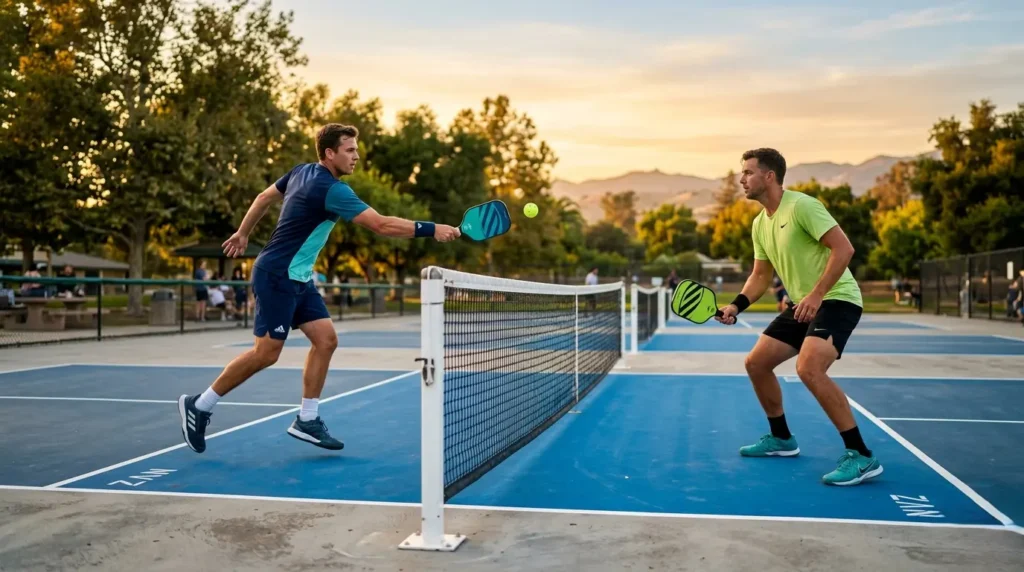
I’ve been playing pickleball on US courts for years — from the crowded morning sessions in Scottsdale to the competitive rec leagues in Tampa and Dallas — and the number one thing that separates players who improve fast from those who plateau is a solid understanding of the rules. Not just the basics, but the real-game situations: what actually counts as a kitchen fault, when a serve is legal, and what changed in the 2025 and 2026 rulebook updates that you need to know before your next session.
Most rules guides online are either a watered-down beginner glossary or a dry, verbatim paste from the USA Pickleball rulebook. I want this to be neither of those things. This is the page I wish had existed when I first started playing — and it’s been fully updated to reflect the current official rules as of January 2026.
Whether you’re picking up a paddle for the first time, getting ready for your first tournament in Phoenix, or just trying to settle a kitchen argument at your local club, this guide covers everything. Let’s get into it.
If you played under the 2023 or 2024 rulebook and haven't checked since, go straight to Section 8 (Faults) and Section 4 (Scoring). The rally scoring provisions and fault-calling protocols have had the most meaningful updates in recent years.
The Pickleball Court — Dimensions, Equipment & What You're Playing On
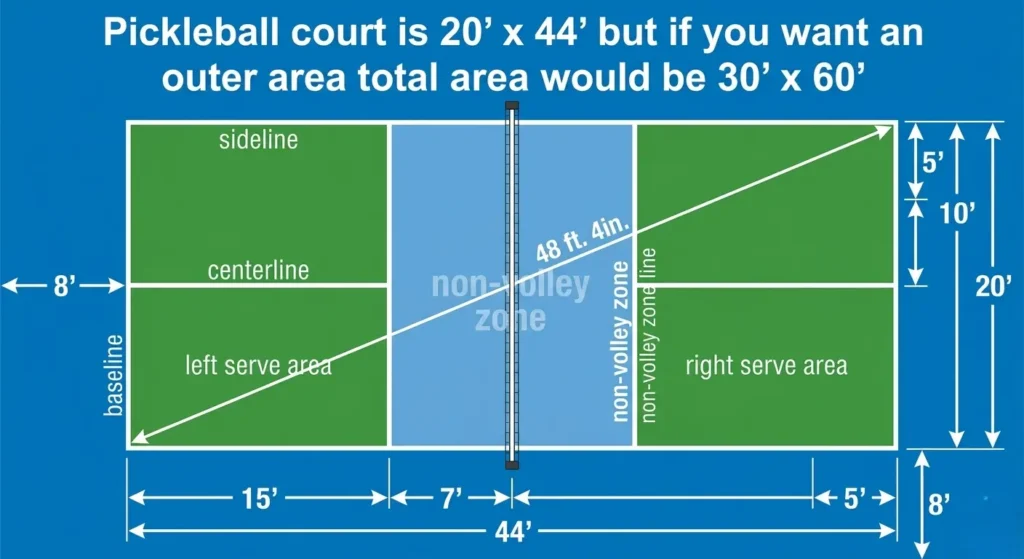
Before you even pick up a paddle, it helps to understand the physical space you’re playing in. A pickleball court is exactly 20 feet wide by 44 feet long — the same dimensions for both singles and doubles play. If you’ve played tennis before, it’s smaller than a tennis court, which is one of the reasons pickleball is so approachable for players of all ages and fitness levels. Many US parks and community centers have converted old tennis courts into two or even four pickleball courts to meet the demand.
The net is set at 36 inches at the sidelines and drops to 34 inches at the center. The center sag matters more than most beginners realize — a lot of skilled players deliberately aim for the center of the net when they have the angle, because there’s two extra inches of clearance there. Since 2025, the official rules also allow a quarter-inch tolerance on net height, so if you’re at a tournament and the net is measuring 34.25 inches at center, that’s legal.
The Non-Volley Zone (The Kitchen)
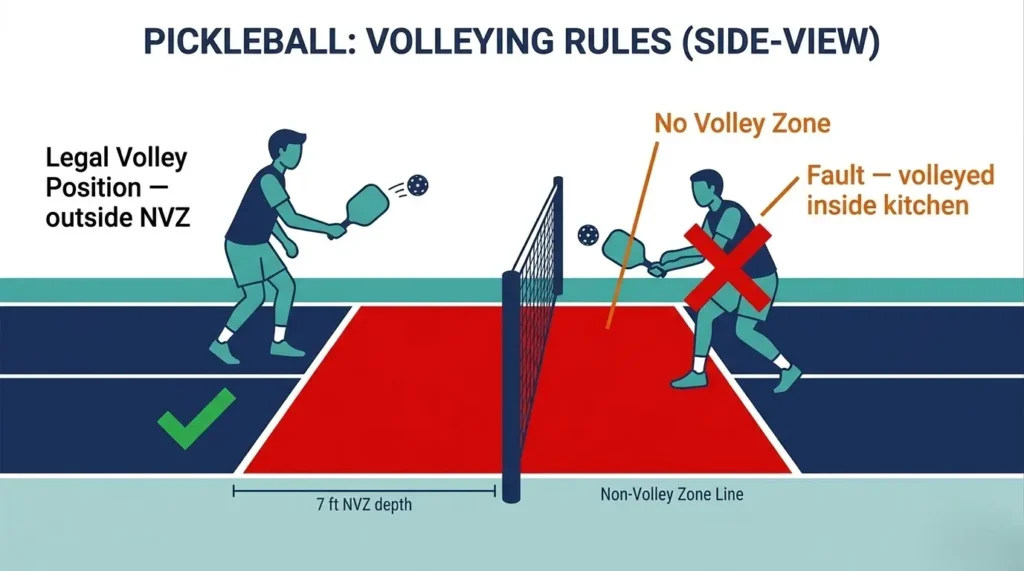
The Non-Volley Zone — universally called the kitchen — is the 7-foot area on both sides of the net. This zone is defined by the NVZ line, and it is the most rule-dense area on the entire court. I’ll go deep on kitchen rules in Section 6. For now, just know that you cannot volley (hit the ball before it bounces) while standing in the kitchen or touching the kitchen line.
Ball Types: Indoor vs. Outdoor
USA Pickleball maintains an official approved equipment list, and balls are divided into indoor and outdoor categories. Outdoor balls are harder, heavier, and have smaller holes to handle wind — they’re typically what you’ll see at outdoor courts in Phoenix and Scottsdale where weather conditions matter. Indoor balls are softer, lighter, and have larger holes. If you’re playing at an organized event, the ball type will be specified by the organizer.
|
🏠
Indoor Ball
|
☀️
Outdoor Ball
|
|---|---|
Softer plastic construction |
Harder, more durable plastic |
Larger holes (26 holes typical) |
Smaller holes (40 holes typical) |
Lighter — more float on the shot |
Heavier — less affected by wind |
Used on gym floors and rec centers |
Used on outdoor concrete/asphalt |
Less bounce variability |
More consistent in windy conditions |
Not sure which ball is right for your court? Our full ball guide breaks down every approved option by surface and play style.
See Ball GuideNot sure which ball is right for your court? Our full ball guide breaks down every approved option by surface and play style.
See Ball GuidePaddle Regulations (2026 Update)
Paddles must meet USA Pickleball specifications to be legal for sanctioned play. The core principle the rulebook introduced is that paddles must not be designed in a way that allows a single playing style to dominate unfairly — this was the language that drove the controversial surface roughness crackdowns of 2024 and 2025. As of 2026, all paddles used in sanctioned tournament play must appear on the current USA Pickleball approved paddle list. Check usapickleball.org before you register for any event — the list updates regularly and paddles do get removed.
For recreational play at your local club or park, paddle rules are relaxed — bring whatever you like. But if you're thinking about tournament play, verify your paddle is approved before you enter. I've seen players show up to tournaments in Dallas and Tampa with paddles that got delisted — it's an avoidable headache.
How Pickleball Scoring Works — Traditional and Rally Scoring
Scoring is one of the first things new players find confusing, and I get it — the three-number score call is unusual if you’re coming from tennis or most other racket sports. But once it clicks, it becomes second nature within a few sessions.
Traditional Side-Out Scoring (The Official Default)
In standard pickleball doubles, only the serving team can score a point. If the receiving team wins the rally, they don’t get a point — they simply win the serve (called a side-out). Games are played to 11 points, and you must win by 2. Tournament finals are sometimes played to 15 or 21, win by 2.
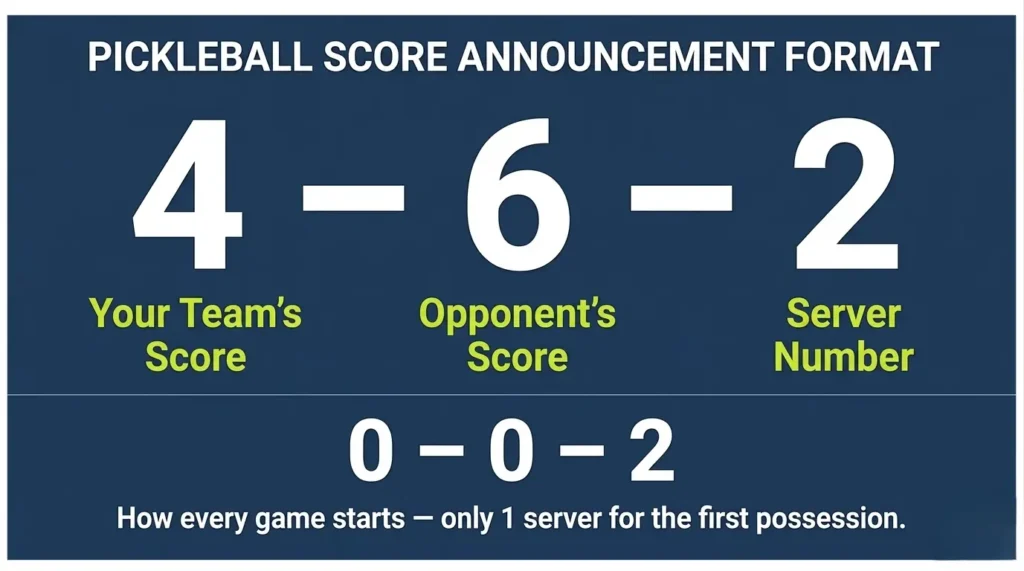
The score is always called as three numbers: your team’s score, the opponent’s score, and the server number (1 or 2). So if your team has 4 points, the other team has 6, and you’re the second server, the call is “4-6-2.” When a new game starts, every team gets only one server for their first possession — so the opening call is always “0-0-2” to signal that a side-out ends the first service immediately.
The '0-0-2' start trips up almost every beginner. Remember: your team only gets one server to begin the game, not two. After that first side-out, normal two-server rotation begins. It's a rule designed to prevent the serving team from having too big an advantage at the start.
One server only — then normal rotation.
Rally Scoring — Now Officially in the 2026 Rulebook
Rally scoring was one of the most debated additions to the official rulebook, and by 2026 it has found a stable home as a provisional format option. Under rally scoring, a point is awarded on every single rally — regardless of which team served. The one exception is the game-winning point: you can only win the game on a rally where your team is serving. This prevents the anti-climactic scenario of a team winning while receiving.
Rally scoring is approved for specific event formats — round-robins, ladder leagues, and timed recreational sessions — but it is not the standard format for most recreational doubles play or double-elimination brackets. If your US club is running a round-robin on a weeknight, there’s a good chance they’re using rally scoring to keep games moving. Always ask the organizer before you start.
|
📋
Traditional Side-Out
|
⚡
Rally Scoring
|
|---|---|
Only serving team scores |
Both teams can score on any rally |
First to 11, win by 2 (standard) |
First to 11, win by 2 (same) |
Score called as 3 numbers (e.g. 5-3-1) |
Score called as 2 numbers (e.g. 5-3) |
Game-winning point: any team |
Game-winning point: serving team only |
Standard for most tournament formats |
Approved for round-robins & timed events |
Not sure which format your club uses? Always confirm with your organizer before your first rally.
Full Scoring GuideNot sure which format your club uses? Always confirm with your organizer before your first rally.
Full Scoring GuidePickleball Serving Rules — What's Legal, What's a Fault, and What's New
The serve is where every single rally begins, and it has its own set of rules that are slightly different from every other shot you’ll hit. I’m going to walk through every legal requirement, then cover the two legal serve types, and finally explain the most important 2025-2026 serving update you need to know.
The Four Requirements of a Legal Serve
Every legal serve must meet all four of these requirements simultaneously:
- The serve must be hit with an underhand motion. Your paddle arm must be moving upward at contact — no overhand or sidearm action.
- The point of paddle contact with the ball must be below your waist (your navel is the reference point in the rules).
- Both feet must be behind the baseline when you make contact. You can’t have a foot on or over the baseline at the moment of the strike.
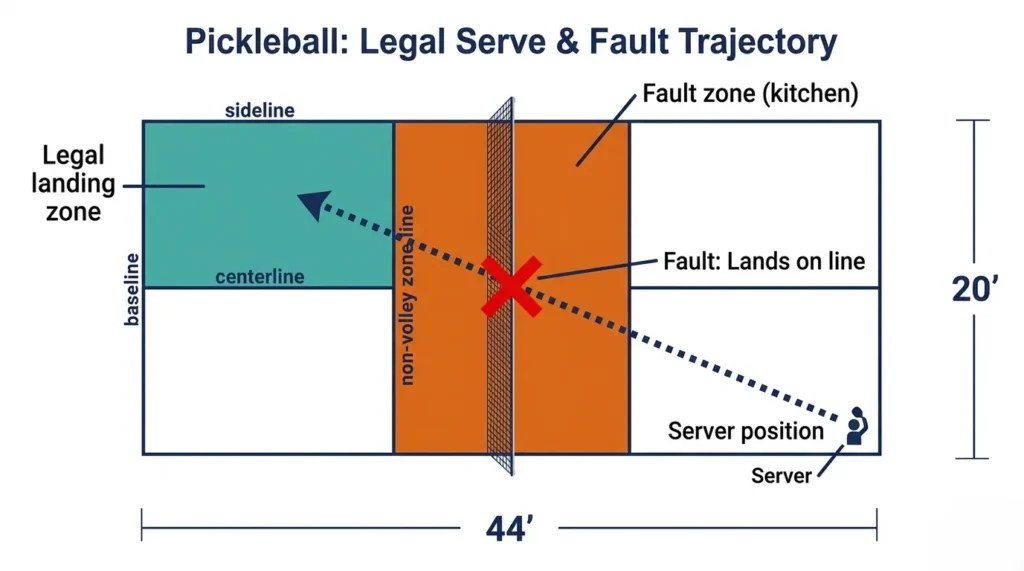
- The serve must travel diagonally across the court and land in the correct service box — past the NVZ line, inside the sideline, and before or on the baseline.
The Two Legal Serve Methods
You have two options when you serve, and both are fully legal under the 2026 rules:
Volley Serve: You toss the ball into the air and strike it before it bounces. This is the traditional serve and the one most players use. You’re in full control of the toss, which is why most recreational players prefer it.
Drop Serve: You drop the ball from any natural height (no throwing it down to add speed — it must be a true drop), let it bounce on the ground, and then hit it after the bounce. The drop serve has no waist-height or underarm requirement — only the foot position and diagonal placement rules apply. It was introduced as an option in 2021 and has been a permanent legal serve method since 2022. Many beginners find the drop serve easier to learn because the bounce gives a more consistent contact point.
The 'Not Ready' Signal — Clarified in 2025/2026
One of the quality-of-life improvements the rulebook made in 2025 — and carried forward into 2026 — is around the ‘not ready’ signal. In non-officiated recreational play, players on the receiving team can now use a clear verbal signal like ‘stop’ or ‘wait’ to indicate they are not ready after the score has been called. Under earlier rules, the server could proceed as soon as the score was called and any resulting fault still counted. The new language makes it clear that players must reasonably signal non-readiness before the serve is struck, and the server should not proceed if that signal is given.
In practice, this mostly affects situations where someone’s sunglasses fell off, a ball rolled onto the court from an adjacent game, or a player’s paddle slipped. It’s a common-sense rule that good players were already following — now it’s official.
Service Sequence in Doubles — The Even/Odd Trick
Knowing which side of the court to serve from is critical and trips up a lot of players, even at intermediate levels. The rule is simple: when your team’s score is even (0, 2, 4, 6, 8, 10…), the first server serves from the right side. When your score is odd (1, 3, 5, 7, 9…), the first server serves from the left side.
This means your position on the court is directly tied to your team’s score. If you’re in the wrong position when you serve, that’s a fault. The cleanest way to self-check: look at your score before every serve. Even = right side. Odd = left side.
When I'm playing in a new group and people are confused about positions, I just say: 'Even score, first server is on the right. Odd score, first server is on the left.' Say it a few times and it becomes automatic. I've used this at courts in Phoenix and Dallas and it helps new players lock it in within a single game.
The Kitchen (Non-Volley Zone) — The Rule That Defines Pickleball
If there’s one section of this guide to read twice, this is it. The kitchen rule — formally the Non-Volley Zone rule — is the most misunderstood, most argued-over, and most strategically important rule in pickleball. I’ve seen more disputes about the kitchen at rec courts in Scottsdale than about every other rule combined.
The basic principle: you cannot volley the ball while you are standing in the kitchen or touching the kitchen line. A volley means hitting the ball before it bounces. If the ball has bounced and you step into the kitchen to hit it, that’s completely fine. But if you’re going to volley from the air, your feet — and your entire body — must be outside the NVZ at the moment of contact and through the completion of your follow-through momentum.
The 2025 Volley Momentum Clarification — A Big One
This is the most significant kitchen rule update in recent years, and it’s still catching players off-guard even in 2026. Under the updated rule, the act of volleying is defined as beginning when the ball is struck and ending when the player’s momentum from the follow-through has fully stopped. Here’s the important part: if your paddle or clothing touches the kitchen before you strike the ball, it is no longer a fault. Only contact that occurs during or after the swing — from the moment of paddle impact through the end of your momentum — is considered part of the volleying action.
Before this clarification, there was a genuine gray area about whether any kitchen contact in the vicinity of a volley counted as a fault. The new language draws a much cleaner line: before you swing, you can touch the kitchen. From the moment you hit the ball forward, you cannot touch the kitchen until your momentum has fully stopped and you’ve regained stable footing outside the zone.
The volleying action now officially begins at the moment the ball is struck — not during the backswing or approach. Pre-strike kitchen contact is no longer a fault under the 2025 clarification carried into 2026. This is a meaningful change for aggressive net players.
Partner in the Kitchen — What the Rules Allow
Here’s a question I get all the time: what if my partner is standing in the kitchen when I volley? The answer: it’s not a fault for you. The kitchen rule applies individually. Your partner can be standing anywhere — including inside the NVZ — while you volley from outside it, and that’s completely legal. The 2025 update added one clarification: partners must not make physical contact with each other during the volleying action. If your partner is in the kitchen and you physically bump or brace against them while volleying, that’s a fault.
The Erne — A Legal Move Worth Knowing
The Erne is one of the more advanced and exciting plays in pickleball, and it’s completely legal if executed correctly. Named after Erne Perry, who popularized the shot, the Erne involves jumping around the outside of the court post while the ball is in play and hitting a volley from outside the kitchen boundary. Because you’re jumping and landing outside the NVZ lines (not inside the kitchen), there’s no kitchen violation — as long as your feet land outside before or at the moment of contact.
In skinny singles (a practice format using half the court), the kitchen on the unused half is considered out of bounds for the rally. This means you can legally jump into that kitchen space to hit an Erne without it being a fault — the kitchen on the non-played side doesn’t trigger the NVZ rule in that context.
The kitchen is the great equalizer in pickleball. It's why a 65-year-old retired teacher in Scottsdale can hang with a 30-year-old former tennis player — the rule slows down power players and rewards patience and placement. Once I really internalized the kitchen rules, my game improved dramatically at the net.
The Two-Bounce Rule (Double-Bounce Rule) — Why It Exists and How It Works
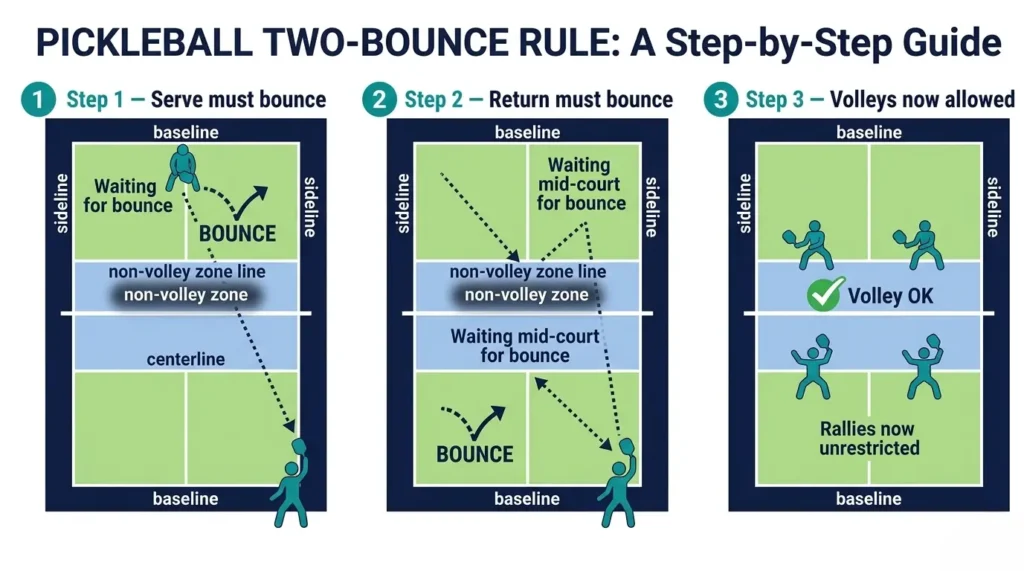
The two-bounce rule is one of pickleball’s most brilliant design decisions, and once you understand why it exists, the whole flow of the game makes more sense. The rule states that after the serve, both teams must let the ball bounce once before they can volley. Specifically: the receiving team must let the serve bounce before they return it. Then, the serving team must let that return bounce before they hit it back. After those two bounces have occurred, both teams are free to volley from anywhere outside the kitchen.
Why does this rule exist? Without it, the serving team could rush the net immediately after serving and establish a dominant position before the rally really began. The two-bounce rule forces the serving team to stay back and receive one more bounce, which equalizes the starting position of both teams. It’s one of the reasons pickleball feels more balanced and less serve-dominated than tennis.
The Most Common Beginner Mistake
The most common error I see from brand-new players is the serving team charging the net after the serve, only to be called for a fault when they try to volley the return before it bounces. It’s a completely natural instinct if you’re coming from tennis — in tennis, rushing the net after a good serve is standard strategy. In pickleball, you have to wait for that second bounce first.
Once the two-bounce requirement is satisfied — serve bounced, return bounced — the rest of the rally has no bounce requirements. You can volley from anywhere outside the kitchen, and that’s where the fast exchanges at the net (called kitchen firefights) happen.
Drill this into your muscle memory in your first few sessions: after you serve, plant your feet and wait. Watch the return hit the ground before you move. That one habit adjustment will save you from dozens of unforced faults early in your pickleball journey.
Pickleball Faults — Every Way a Rally Can End
A fault ends the rally. If the fault was committed by the serving team, the serve is lost (or a side-out occurs if it was the second server). If the fault was committed by the receiving team, the serving team earns a point. Here is a complete breakdown of every category of fault you need to know.
Serving Faults
- The serve lands in the kitchen or on the NVZ line (kitchen line).
- The serve lands out of bounds — outside the correct service box.
- The ball is hit with a sidearm or overhand motion.
- Paddle contact is above the waist at the moment of the strike (volley serve only).
- One or both feet are on or over the baseline at the moment of contact.
- The serve hits the net and doesn’t land in the correct service box (a net serve that clips and lands correctly is let — replayed — at most levels).
Kitchen / NVZ Faults
- Volleying the ball while standing in the kitchen or on the NVZ line.
- Stepping into the kitchen during the volley’s follow-through momentum before it fully stops.
- Any body part, paddle, clothing, or accessory touching the kitchen during the act of volleying.
- Entering the kitchen and volleying before your momentum from a previous volley has stopped.
Out-of-Bounds Faults
- The ball lands outside the court boundaries (sidelines, baseline).
- The ball passes through the net rather than over it.
- The ball lands on the wrong side of the court on the serve.
Net Faults
- Hitting the net with your paddle or body during play.
- Reaching over the net to hit the ball before it has crossed to your side (except when following through after the ball has crossed back).
- The ball hits the net post and goes out — this is a fault (dead ball).
Fault Calling in Non-Officiated Play — 2025/2026 Update
This update changed how and when faults are called in the recreational game most of us play every day. The current rule states that in non-officiated matches, most faults should be called after the rally is over — not in the middle of play. The exceptions are NVZ faults and service foot faults, which can still be called immediately since they’re clearly observable at the time they happen.
The rationale is to prevent mid-rally interruptions that halt what might have been a continuing, valid rally. If you notice a fault midway through a long exchange, wait until the point is over and then address it.
In non-officiated recreational play, wait until the rally ends before calling most faults. Only NVZ violations and service foot faults should be called immediately. This prevents disruptive mid-rally stoppages and is official policy as of 2025, carried into 2026.
Partner Disagreement on a Fault Call
Here’s a situation that comes up more than you’d think: you and your partner disagree on whether a fault occurred. Maybe you thought the ball was out, your partner thought it was in. Under the current rules, when partners on the same team disagree about a fault call, the call goes in favor of the opponents. This is the same principle as a disagreement on a line call — any doubt goes to the other team.
Spectator Line Calls — Now Explicitly Prohibited
This was a direct response to a practice that had become common at some recreational venues: a spectator on the sideline yelling ‘out!’ and influencing the call. Under the 2025 rule — still in effect in 2026 — spectators are explicitly prohibited from being consulted on any line call. Players are equally prohibited from accepting or acting on unsolicited input from spectators. If a spectator calls a line, both teams must disregard it as if it never happened.
Line Calls — How to Make and Receive Calls Correctly
Pickleball’s self-officiating culture in recreational play means line calls are a major part of the social contract at your club. Getting them right — and handling disputes graciously — is as important as knowing the rule itself.
The Basic Line Call Rule
In pickleball, if a ball lands on any line, it is in. This applies to the sidelines, baseline, and the centerline on the serve. The one exception is the NVZ line on a serve: if the serve lands on the kitchen line, it is a fault. Every other line is in.
Calls are made by the team on whose side of the court the ball lands. You call balls on your side; your opponents call balls on their side. You should never call your own return out — that’s your opponent’s call. The honor system here is taken seriously in the pickleball community, and players who call balls out generously in their own favor develop a reputation quickly.
When You’re Not Sure
If you genuinely can’t tell whether a ball was in or out, the rule is clear: call it in. Any ball you are not 100% certain was out must be played as in. This is not just a courtesy — it is the official rule. Uncertainty equals in.
Tournament Line Call Appeals
In officiated tournament play, you have the right to appeal a line call to the referee, but there’s a firm deadline: the appeal must be filed before the scoresheet for that match is initialed. Once the scoresheet is signed off, the results and calls are final. This gives players a real opportunity to raise concerns while keeping the tournament on schedule.
Sportsmanship & Conduct — What the Rules Expect From You
Pickleball has a reputation as one of the most welcoming and sportsmanlike recreational sports in the US, and the official rules actually codify the conduct expectations that good players already live by. The 2025-2026 rulebook has a clearer, more graduated system for addressing on-court behavior than any previous edition.
The Conduct System
The current system works in escalating tiers:
- Verbal Warning: Issued for minor infractions like a single instance of profanity or a brief, non-escalating argument about a call. It’s a warning — no point penalty.
- Technical Warning: Given for more serious behavior — sustained arguing with a referee, equipment abuse (throwing a paddle), or making a second borderline remark after a verbal warning. Still no point change, but you’re on notice.
- Technical Foul: The most serious non-disqualification penalty. A technical foul awards a point directly to the opposing team. This is reserved for aggressive actions, direct threats, or continuing prohibited behavior after a technical warning.
- Ejection / Withdrawal: For the most extreme cases, the tournament director can remove a player from the event entirely.
A 2025 provision — still active in 2026 — allows tournament directors to issue a technical warning or foul that carries over into a player's next match. If you receive a technical warning in your semifinal and behave poorly again, that history follows you into the final.
The spirit of the conduct rules reflects what the pickleball community has always valued: respect for opponents, honesty in calls, and enjoyment of the game. I genuinely believe pickleball’s culture is one of its biggest competitive advantages over other sports for attracting new players. The 2026 rules protect and formalize that culture.
I've played at courts all over the US — from competitive venues in Dallas to laid-back morning sessions in Scottsdale — and the one thing consistent everywhere is that how you handle a bad call says more about you than your DUPR rating ever will.
Call the close ones in your opponent's favor and your reputation on the court will be sterling.
Singles vs. Doubles — What Changes When You're Playing Alone
Most of what I’ve covered so far applies equally to singles and doubles play. But there are a few meaningful differences in singles that are worth knowing, especially if you’re practicing alone or your club runs singles ladders.
Serving in Singles
In singles, there’s only one server per side — no first server/second server system. When you win the serve, you serve. When you lose a rally, the serve transfers to your opponent. The three-number score call reduces to two numbers in singles: your score, then your opponent’s.
The even/odd positioning rule still applies in singles: if your score is even (0, 2, 4…), you serve from the right side. If your score is odd (1, 3, 5…), you serve from the left side. Your position on the court is always tied directly to your own score.
Skinny Singles
Skinny singles is a practice format, not an official game type, but it’s widely used at US clubs for drilling and conditioning. You play on half the court — either both players use the even/right-side boxes, or both use the odd/left-side boxes. It’s a great way to get full singles practice on a court that’s also being used for other players.
The kitchen on the unused half is considered out of bounds for that rally, which creates some interesting strategic dynamics — including the Erne opportunity I mentioned in Section 4.
Scoring in Singles
Singles follows the same scoring format as doubles: first to 11, win by 2, with traditional side-out scoring as the default. Rally scoring is available as a provisional format in singles as well under the same conditions as doubles.
Playing in Your First US Pickleball Tournament — What You Need to Know
Thinking about entering your first tournament in Scottsdale, Tampa, Phoenix, or Dallas? Tournament play introduces a layer of structure on top of the recreational rules I’ve covered. Here’s what changes and what to expect.
Equipment Approval
Your paddle must be on the current USA Pickleball approved equipment list. Check the list at usapickleball.org before you register — not the day before. Paddles get added and removed regularly, and showing up with a non-approved paddle will result in a required equipment change before you can play.
Player Ratings: DUPR and USAP
Most US tournaments use DUPR (Dynamic Universal Pickleball Rating) as the skill rating system for bracket placement. DUPR uses a dynamic algorithm that weights your results against opponent ratings. Some events use the legacy USAP (USA Pickleball) rating system. When you register for a tournament, confirm which rating system is being used for bracket placement so you enter the right skill division.
Medical Timeouts
Each player is allowed one medical timeout per match of up to 15 minutes. A medical timeout is for genuine on-court injuries or medical issues — not for fatigue or equipment adjustments. A referee must be present to confirm the medical timeout is appropriate. If a player cannot continue after the medical timeout, they are considered to have retired from the match.
Round-Robin Tie-Breaking — 2025/2026 Update
This one caused a bit of confusion when it changed. The 2025 rulebook reverted round-robin tie-breaking back to the method used in 2023 and earlier: point differential across all tied teams. So if three teams are tied in wins at the end of a pool, the tiebreaker is the net point differential — total points scored minus total points allowed — across all games. The method that was briefly used in 2024 has been retired.
Round-robin tiebreakers in 2025 and 2026 use point differential across all tied teams — the same method as 2023. If you played under the brief 2024 system, this is back to the format you likely knew before.
Team Withdrawal During Pool Play
If a team withdraws during round-robin pool play, all of their match results — including matches they already played and won — are removed from the records of all remaining teams. This is designed to prevent a withdrawn team’s results from creating unfair advantages or disadvantages in the tiebreaker calculation for the remaining competitors.
Frequently Asked Questions
Updated for 2026 USA Pickleball rules — the questions I hear most on US courts.
The kitchen (Non-Volley Zone) is the 7-foot area on both sides of the net. You cannot volley — hit the ball before it bounces — while standing in the kitchen or touching the kitchen line. You can enter the kitchen to play a ball that has already bounced there.
The 2025 clarification (still in effect for 2026) established that only contact during and after your swing counts as a violation — pre-swing kitchen contact is no longer a fault.
Only the serving team scores. Games go to 11, win by 2. The score is called as three numbers: your score — their score — server number (1 or 2). Every game starts at 0-0-2 because each team only gets one server to begin.
1. Volleying momentum rule — Pre-swing kitchen contact is no longer a fault. Only contact from ball impact through follow-through counts.
2. Fault-calling in rec play — Most faults should be called after the rally ends, not during it.
3. Spectator line calls banned — Players cannot accept or act on any unsolicited spectator input.
4. "Not ready" signal — Receivers can now officially signal non-readiness before a serve is struck.
5. Round-robin tiebreaking — Reverted to point differential across all tied teams.
No. You cannot volley from inside the kitchen or while touching the NVZ line. You can enter the kitchen at any time — but only to play a ball that has already bounced there. Once inside, both feet must fully clear the NVZ line before you can volley again.
Both the serve and the return of serve must bounce before being hit. After those two mandatory bounces, both teams can volley freely outside the kitchen. This rule stops the serving team from rushing the net right after serving and keeps the game balanced.
It's a fault — rally dead, other team wins the point or the serve. Contact with the permanent post is treated differently than a net cord (where the ball clips the top of the net and goes over). Even if it somehow lands in bounds, it's still ruled a fault.
Yes — it's in the official rulebook as a provisional option for round-robins and timed recreational events. It is not the default for standard doubles or most tournament formats. Under rally scoring, a point is awarded every rally — but the game-winning point can only be scored by the serving team. Always confirm with your organizer before you start.
No. Spectators are explicitly prohibited from being consulted on line calls. Players are also banned from accepting unsolicited input from anyone on the sideline. If a spectator calls a ball out, both teams must disregard it entirely and play on.
A fault is any rules violation that ends the rally. Serving team fault = lost serve or side-out. Receiving team fault = point for the serving team. Most common faults: ball out of bounds, volleying from the kitchen, violating the two-bounce rule, service foot faults, and hitting the net with your paddle or body.
Volley serve: Toss and hit before it bounces. Must be underhand with paddle contact below your waist. Drop serve: Drop the ball, let it bounce, hit after the bounce. No waist-height or arm-angle rules apply — only foot position and diagonal placement. Both are fully legal in 2026.
Now That You Know the Rules, Time to Apply Them
Understanding the rules is the foundation. The next step is making sure you have the right equipment to play your best game on US courts — and we’ve put together the resources to help you do exactly that.
Ready to Apply These Rules on the Court?
Find a USA Pickleball-approved paddle that fits your game and your budget. Our full guide covers every major price tier.
The three-number scoring system explained with real-game examples. Perfect for players in their first month.